Why Google Says Go Is the Ideal Language for AI-Assisted Development
Hey everyone!
Google published a post on their developer blog called “Why Go is an ideal language for AI-assisted software engineering.” I started reading it and here’s what I took away after using Go with AI agents day-to-day.
What changed in software development
Google opens the article with an observation that captures the current moment well:
“Where we once wrote most lines of code by hand, we now ask AI coding assistants and agents to generate large swaths of code for us.”
If you use Claude Code, Cursor, Copilot, or any similar tool, you know the dynamic has shifted. The bottleneck is no longer writing code, it’s reviewing and validating what the model generated. And that shift has direct implications for which language makes the most sense to use.
The article argues that software engineering has never been just programming. It’s long-term collaboration, it’s keeping systems running for years, it’s working in large teams with distributed context. Go was designed exactly for that scenario, even before AI entered the picture.
Readability as a design priority
Go has an explicit design philosophy: readability over writability. You write a bit more than you would in Python, but anyone can read and understand what the code does without needing extra context.
This isn’t accidental. gofmt has no configuration options. Formatting is unique, mandatory, and applied automatically. There is no style debate in Go projects.
The practical result: when an agent generates Go code, you can audit it line by line without having to trace what some decorator or middleware is doing implicitly. In Python or JavaScript, a small decorator can completely change the behavior of a function. In Go, the behavior is in the code you’re reading.
This also means there’s no style divergence between the code you wrote and the code the agent generated. Everything goes through the same gofmt. The diff stays clean and focused on what actually changed.
Fast compilation and the autocorrection loop
Google highlights that Go compiles “orders of magnitude faster than Java, C#, Rust, and other compiled, production-grade languages.”
Why does this matter when you’re using AI? Because AI agents work in loops. They generate code, compile, analyze the error, fix it, and compile again. That cycle can happen dozens of times in a single task.
With Rust or Java, each iteration of that loop costs seconds, sometimes tens of seconds on larger projects. With Go, it’s milliseconds. You fit many more iterations into the same time, and the agent can fix problems before you need to intervene.
There’s also a less obvious effect: fast compilation makes the feedback loop between human and agent shorter. You test, see the result, adjust the instruction, and come back. When compilation takes a while, that cadence breaks.
Static typing as an automated safety net
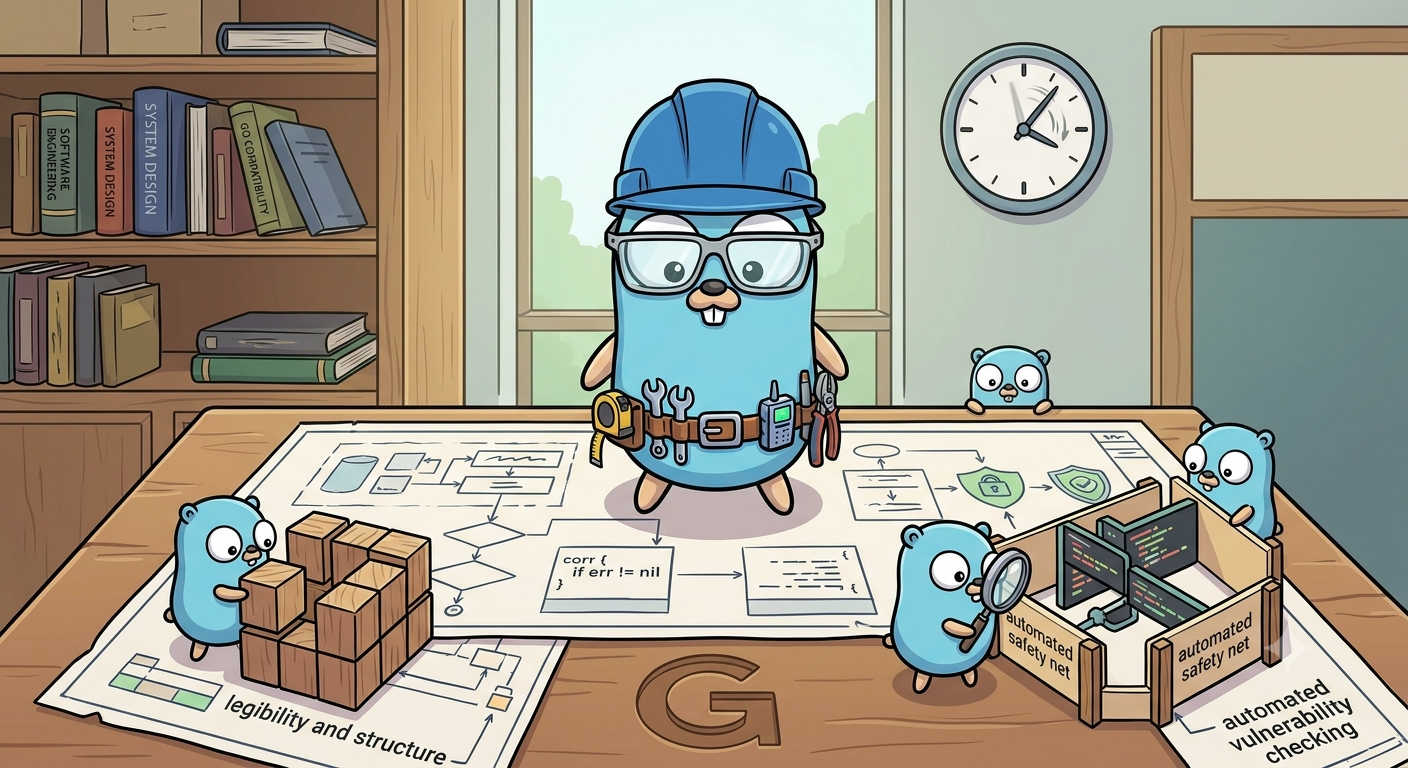
The article describes Go’s type system as an “automated safety net for agentic code.”
AI models make specific mistakes frequently: they mix up types in function signatures, pass parameters in the wrong order, try to use a nil value where a concrete interface was expected, or return the wrong type from a generic function. In dynamic languages, these errors only show up at runtime, often in production.
In Go, the compiler rejects them before the binary exists. The agent receives the compilation error, reads the message, fixes it, and tries again. That cycle is fast and happens locally, without needing to run the application.
One important detail: Go’s compilation errors are deliberately descriptive. They say exactly what’s wrong and where. That’s not a coincidence, it’s part of the language design. And descriptive error messages are especially useful for AI models, which depend on textual feedback to correct their own code.
Long-term compatibility
One of the most interesting arguments in the article is about compatibility:
“Code written for Go 1.0 continues to work unchanged in the latest version. There will never be a Go 2.0.”
Go’s compatibility promise is an explicit engineering requirement, not an intention. The team maintains a test suite that verifies code written for older versions still compiles and works in newer ones.
For AI, this has two practical implications.
The first is about training: when a model learns Go, that knowledge doesn’t become stale the same way Python 2 vs 3 does, or with APIs that change between versions of React or Spring. What the model learned about Go 1.18 is still valid in Go 1.27.
The second is operational: you won’t discover that code the agent generated last year broke because the language changed under it. This reduces the maintenance cost of AI-generated code over time, something that doesn’t get enough attention in discussions about AI productivity.
Native tools the agent can use
Go ships with a set of tools an agent can use directly, without extra configuration:
gofmt, automatic, consistent formatting. The agent doesn’t need to make style decisions and the resulting code is indistinguishable from human-written code in terms of formatting.
govulncheck, vulnerability scanner integrated into the toolchain. It’s low-noise by design: it only reports vulnerabilities that affect code you actually call, not the entire dependency graph. An agent can run it and act on the results without generating alerts that don’t apply to the project.
Native fuzz testing, since Go 1.18, fuzzing is part of the stdlib via testing.F. An agent can generate fuzz cases as part of the normal testing flow, without configuring external tools.
go fix, automatic code modernizers. Go 1.26 brought a new implementation that migrates old patterns to new ones automatically. An agent can use this to update legacy code without manually rewriting each occurrence.
Profile-guided optimization (PGO), the compiler can use production profiling data to optimize the binary. An agent can incorporate this step into the build pipeline without additional toolchain.
Checksum database and module mirror, Go has a centralized infrastructure that records checksums for every module ever published. This makes it very hard for a compromised dependency to enter the system undetected. When an agent adds a dependency, it’s automatically verified against that registry.
Fewer external dependencies
The article mentions Go’s “batteries-included” philosophy as supply chain risk mitigation.
Go’s stdlib covers HTTP, JSON, cryptography, testing, profiling, synchronization, I/O, and much more. In many cases, an agent can solve a problem without adding any external dependency.
This matters for two reasons. The first is security: every external dependency is a potential attack surface. The second is stability: the fewer dependencies a project has, the fewer things can break when a third-party library changes or stops being maintained.
In practice, Go projects tend to have smaller dependency graphs than equivalent projects in Node.js or Python. And when an agent is generating code, it naturally gravitates toward what it already knows, and the Go stdlib is well-documented and consistent enough that models know it well.
Go as a working environment for AI
The article ends by positioning Go not just as a language but as an environment where humans and AI can work together more safely. The phrase used is that Go provides “strong guardrails”, constraints that make the agent’s work more predictable and the review work simpler.
That matches my experience. When I use Claude Code on Go projects, the errors that come up are usually compilation errors, specific, localized, and easy to fix. On Python projects, errors tend to show up at runtime, in unexpected contexts, and require more investigation to understand what happened.
My take after using this in practice
The arguments hold up in practice. The design decisions the community criticized for years, the verbose if err != nil, the lack of metaprogramming, the rigid compiler, are the same ones that make AI-generated code easier to review and validate.
That doesn’t mean Go is the right language for every project. But if you’re choosing a language for a system where agents will frequently generate and modify code, these factors are worth considering alongside ergonomics for manual writing.
Have you used Go with any AI agent? What was your experience? Tell me in the comments.
See you in the next post!
Reference: Why Go is an ideal language for AI-assisted software engineering, Google Developers Blog